(Article)
Foodpairing, the science of flavour matching
By Beatrice Vernocchi
Food Trends and Business Opportunities
Do you know what foodpairing is? It's the scientific study of flavour matching (based on molecular composition). The method rests on the principle that foods combine well with each other when they share their most important aromatic components.
The foodpairing process begins with an aromatic analysis of the product to be matched. The product's aromatic profile is determined through gas chromatography combined with mass spectrometry (GC-MS). In practice, this analysis separates and identifies the various flavour components.
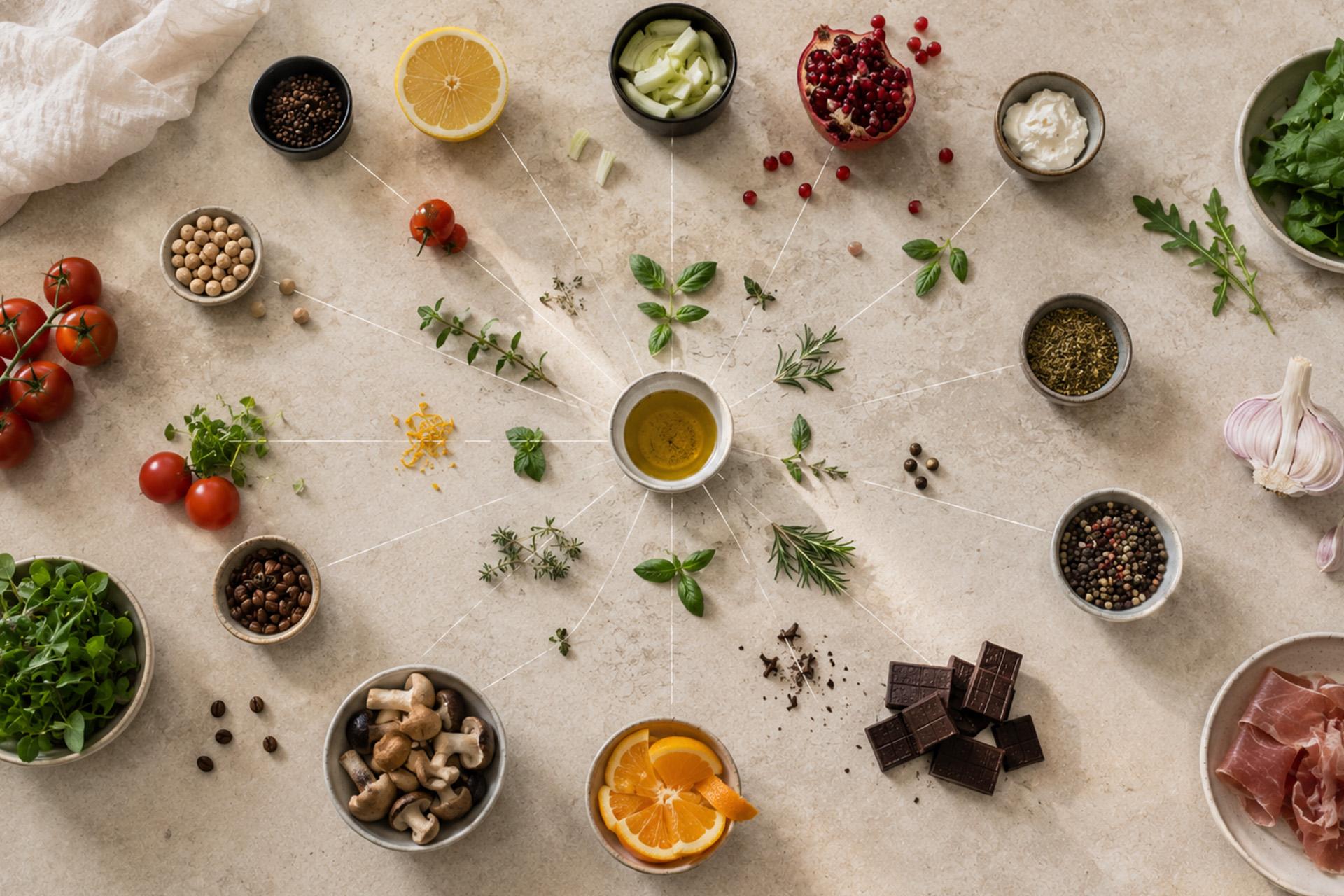
Once a food's flavour components have been analyzed, they are compared against a database of several hundred other products (food & beverage). Those that turn out to share flavour components with the food under study are then represented in a tree diagram, with the chosen food placed at the center of the structure and surrounded by its possible combinations.
The foodpairing tree thus becomes a visual aid for chefs and bartenders, making the creative process easier. Choosing pairings becomes simpler and more immediate, freeing them to focus on other elements when creating a dish or a cocktail.
But how did this science come about? In 1992, Heston Blumenthal (chef of The Fat Duck restaurant, London) and Francois Benzi (a flavour chemist for Firmenich) proposed that great dishes could be created by combining foods that share components with a common taste.
In 2004, Sense for Taste began studying this hypothesis. Three years later, in 2007, the website foodpairing.com was presented for the first time at the famous Spanish food event "Lo mejor de la gastronomia", where it was met with great interest and enthusiasm.
The initial proof-of-concept was carried out in collaboration with top chefs such as Sang-Hoon Degeimbre (L'air du temps, two Michelin stars) and Sergio Herman (Oud Sluis, 20/20 Gault Millau, three Michelin stars). Today Sense for Taste has built a database containing more than 1,000 ingredients along with their corresponding aromatic profiles.
We can safely say that today foodpairing is both a scientific study of flavours and a food trend not to be underestimated. Sense for Taste doesn't just support industry professionals (chefs, food companies, bartenders, and so on), but also reaches out to food enthusiasts of all kinds, giving them the option to take out annual subscriptions on foodpairing.com to use the pairing database.
But the business opportunities don't end here: inspired by this approach, an iPhone app called "Wine and Food Pairing" (by Brian Call) was also created, aiming to instantly provide the right wine/food pairing (also flagging pairings to avoid).
And the possibilities for developing foodpairing in marketing, communication, and creativity are still very broad. We look forward with curiosity to what comes next…